
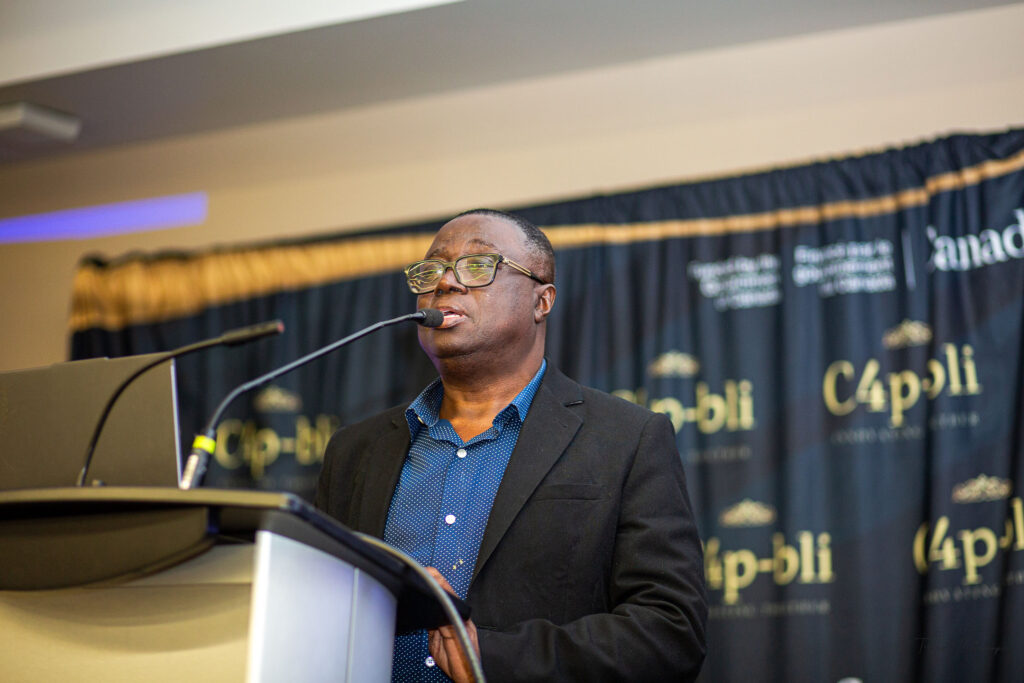
At the Global Evidence & Impact Conference (GEIC) 2025, the conversations were not always comfortable, but they were necessary. Among the voices that challenged conventional thinking was Dr. David Firang, an Associate Professor at Trent University, whose reflections on equity and opportunity sparked deep introspection across the room.
His message was clear, bold, and impossible to ignore:
we cannot talk about equal opportunity without addressing unequal conditions.
Key Highlights:
1. Equal Opportunity Begins With Equal Conditions
Drawing from both lived experience and academic insight, Dr. David Firang questioned the systems we often assume are fair.
While many institutions promote equity, diversity, and inclusion, he pointed out a critical gap. True equality cannot exist if people are starting from vastly different realities.
He illustrated this with a powerful contrast:
- One individual born into immense wealth and privilege
- Another raised in a socially deprived community with limited access to resources
Can both truly have the same opportunity?
The answer challenges the very systems we rely on.
2. The Illusion Of Inclusion
One of the most striking ideas from his session was the concept of tokenism.
Systems may claim to create equal opportunities, but without addressing deeper structural inequalities, those efforts risk becoming surface level gestures.
According to Dr. David Firang, this creates an illusion of fairness rather than actual change. Representation without structural support does not lead to real equity.
3. The Pushback Against Critical Conversations
Dr. Firang also highlighted a growing global shift, the resistance against conversations around critical race theory and equity focused frameworks.
He shared a moment from his classroom, where a student expressed support for removing such frameworks altogether. This reflects a broader tension in society, where efforts to address inequality are sometimes misunderstood or rejected.
Yet, these conversations remain essential if meaningful progress is to be made.
4. From Awareness To Responsibility
Perhaps the most powerful takeaway was this:
our responsibility is not just to observe inequality, but to address its root causes.
Dr. Firang urged us to move beyond surface level solutions and instead:
- Identify systemic barriers
- Create enabling environments
- Build conditions that allow everyone to thrive
Because without changing the conditions, opportunity will always remain unequal.
The Bigger Reflection
This session reminded us that equity is not just a policy or a checkbox. It is a continuous, intentional effort to level the ground on which people stand.
At GEIC 2025, we were not just asked to listen, we were challenged to rethink, question, and act.
The Ripple Continues
As the conversations from GEIC continue to unfold, one truth stands firm:
real impact requires more than good intentions, it demands structural change.
And perhaps the most important question we carry forward is this:
Are we creating opportunities, or are we creating the conditions that make those opportunities truly accessible?
Want to dive deeper into the insights? Visit c4p-bli.ca/2025geic/ for more information and to stay updated on our upcoming initiatives.